
Abilene Previous Residents by Record Era
Previous residents of an Abilene address leave different kinds of traces in each era. A Taylor Central Appraisal District record is a current property clue, while Taylor County Clerk instruments track recorded parties and legal descriptions. Historical city directories can identify a household or business association, and maps can place an old address on a block. The sources overlap, but none is a complete list of everyone who lived at an address.
| Historical source | Period available | Where it is held | What it can establish |
|---|---|---|---|
| Taylor CAD property search | Current appraisal records | Taylor Central Appraisal District | Parcel, owner display, property ID, situs, and legal-description clues |
| Taylor County official property index | About 1972 or 1973 to current for property indexing | Tyler Super Search and County Clerk | Recorded party roles, instruments, dates, and an image when available |
| County hand indices and deed material | Earlier property trail into the late 1800s | County Clerk and FamilySearch catalog | Older grantor-grantee work when the online cutoff intervenes |
| Abilene directories | Located online from 1901, with later gaps | Texas History Portal, Main Library, and Texas State Library | Dated household, street, occupation, business, and family clues |
| Sanborn maps and tax rolls | 1896 map; tax-roll filming varies | Library of Congress and Texas State Library | Block, building, and assessment context, not a complete resident list |
Start with the current parcel when the address is known. Start with the available directory year when the person or a former street name is known. If the date falls before the online property cutoff, plan for the clerk's hand indices, the library, or an archive instead of expecting a web result.
Abilene Previous Residents Start With a Parcel
A parcel record is the cleanest way to separate a physical location from a mailing address. In the Taylor Central Appraisal District property search, test the address with its street number and street name. The portal advises omitting directional prefixes, suffixes, and unit numbers. If that fails, try the first few street letters, an owner name in last-name-first order, a property ID, a geographic ID, subdivision, or neighborhood field.
Record the source's own terms: account or property ID, geographic ID, situs address, mailing address if shown, subdivision, tax year, map link, and legal-description clue. A situs address is the physical location tied to the parcel. A mailing address is where correspondence is sent and can be elsewhere. Neither one alone proves that every person at that place was a resident.
Note: CAD legal descriptions and acreage are appraisal information and must be verified against a recorded instrument for an authoritative chain.
Follow Taylor Deeds for Abilene Previous Residents
Once the parcel gives a current owner or legal-description clue, move to the Taylor County Tyler Super Search. The county describes this index as a public service and a guide to the underlying record, not a certified copy. It adds records daily, and images can be unavailable while backups run. Search spelling variations and check the recorded instrument before drawing a conclusion.
- Save the CAD property and legal-description clues, then look for the current owner as a grantee in the recorded index.
- Open the most recent deed or deed of trust and record its grantor, recording date, document number, and legal description.
- Search that seller as a grantee to locate the earlier purchase, then identify the prior grantor.
- Repeat the same alternating grantor-grantee pattern, comparing each instrument's lot, block, subdivision, or metes-and-bounds language.
- When the property trail reaches the online cutoff, use county hand indices, clerk assistance, and cataloged Taylor deed material rather than treating the web index as exhaustive.
- Grantor
- The party transferring an interest in a recorded instrument.
- Grantee
- The party receiving the interest. A prior purchaser is often found by searching that person as a grantee.
- Chain of title
- The linked sequence of recorded transfers associated with a parcel or legal description.
- Legal description
- The lot, block, subdivision, or metes-and-bounds description in an instrument. It is often steadier than a street label over time.
Abilene Previous Residents Beyond the Web Cutoff
Taylor County describes real-property records beginning in the 1870s, but its online property index is described as beginning around 1972 or 1973. Other official-public-record categories may reach to the county's 1878 beginning, so record type matters. For an earlier property transfer, ask the County Clerk about hand-index assistance and use the FamilySearch catalog, which lists Taylor County direct and reverse deed indexes for 1879-1929 and deed records for 1903-1929.
The county's digitization story is large but not a promise that every historic property search is online. Its official records page describes more than four million images and about four terabytes of imagery, along with a paperless and e-recording transition in 2007. Retired County Clerk Larry G. Bevill is credited with digitizing and indexing the records. That work made a broad collection more accessible while older property tracing still requires a careful hand-index strategy.
See the Taylor County official-records search used for the online portion of the trail.
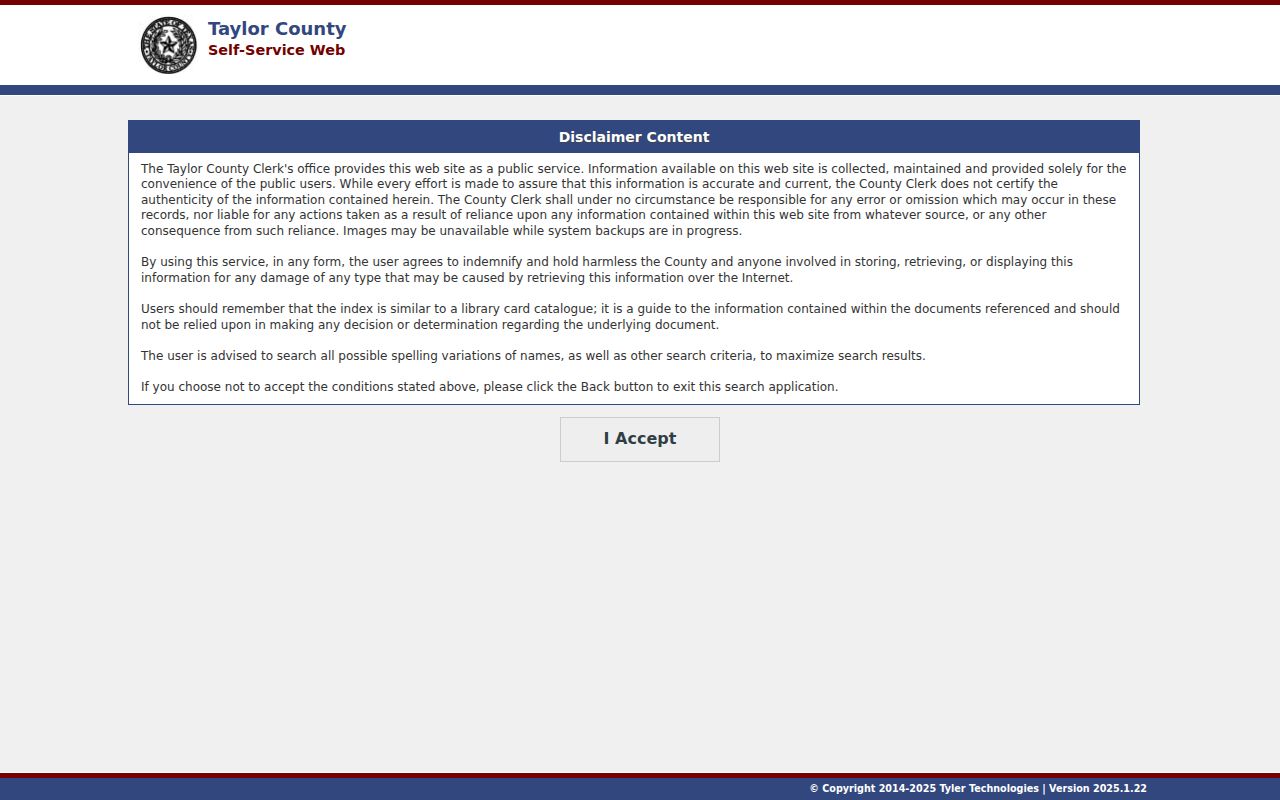
The portal image reinforces the distinction between a discovery index and the clerk-held document needed for a certified or fully verified record.
Abilene Previous Residents Need Legal Descriptions
Do not abandon an old address when a present street-number search fails. The clerk's recorded legal description may preserve the lot, block, subdivision, or metes-and-bounds wording even if the street label changed. Plats connect that legal wording to a street, while the City of Abilene GIS viewer and planning maps supply modern civic context. Taylor CAD mapping data is not a legal survey, and the district says its data is constantly revised.
The research did not locate an official citywide Abilene street-renumbering year or a definitive renamed-street table. That gap is important. Compare directory cross-streets, plats, Sanborn sheets, and the deed description rather than supplying a made-up conversion. The 1901 directory's bt. block notation can identify a segment of a street even where a modern number does not match.
Pair Abilene Past Residents With Census
Deeds identify recorded interests, not necessarily the people who lived at an address. To reach past residents, pair a directory year with the closest available census and then test the result through a newspaper, obituary, probate record, or cemetery route. The 1901 and 1905 books can supply block or household lines. The 1939-40 Worley volume adds home and room/rental marks, spouse parentheses, child-count clues, and occupation text on observed pages.
- Choose a dated directory entry that has a street, block, spouse, family, or business clue.
- Compare it with the closest census year, preserving the year, county, precinct, and city label used by that historical record.
- Check a newspaper date or Big Country Obituaries for a move, death, marriage, or family event that explains a change.
- Return to the deed chain and legal description if the address itself is uncertain or a property transfer needs confirmation.
The collections and their publisher details belong with the Abilene city directory collections. Use them here as dated household evidence, not as a statement about current occupancy.
Abilene Previous Residents at the Library
The Abilene Public Library genealogy and Texas History resources are the offline bridge when a parcel trail needs a household clue. Main Library provides a Texas History and Genealogy room, microfilm readers, public computers, Ancestry Library Edition, HeritageQuest, print family histories, annuals, indexes, and staff help. HeritageQuest can search city directories, census material, and mortality schedules. The library databases also list Texas Historical Newspapers for Abilene titles with different date ranges.
The Main Library facility page lists 1699 South 1st Street, Suite 100, and phone 325-676-6328. Current listed hours are Monday, Tuesday, and Thursday from 9 a.m. to 9 p.m.; Wednesday, Friday, and Saturday from 9 a.m. to 6 p.m.; it is closed Sunday. Confirm the location before travel, because early 2026 materials still referenced the former Main Library at 202 Cedar.
Open the library source page for the resources behind this historical route.

The library supplies a place to compare a microfilm directory, an online scan, a census database, and a newspaper item without claiming that any single one is a full address roster.
Abilene Previous Residents on Blocks and Maps
The Library of Congress holds a five-sheet 1896 Sanborn map record for Abilene. It can show blocks, streets, buildings, and business structures, making it useful when a directory line gives a cross-street interval instead of a familiar number. It does not identify every person who lived on a block. Combine the map with a directory page, plat, tax-roll clue, or deed legal description.
Directory geography also changes. The Texas State Library says the neighboring place of Impact is included in Abilene in the 1988 directory. A matching city label therefore does not guarantee the same municipal geography as a present parcel. Preserve the source year and compare its county and city context before joining it to a modern address.
Abilene Previous Residents: Lawful History Work
Online access includes Taylor CAD, Tyler Super Search, UNT directory scans, the Texas State Library holdings list, FamilySearch catalog material, and Library of Congress maps. In person, use the CAD office, County Clerk public-record terminals and hand indices, the Main Library genealogy room, or the Texas State Library reading room. The County Clerk's department page lists 325-674-1202, and its copy-request form is the documented mail route for county copies.
The County Clerk page still displays 300 Oak Street, Suite 100, but a February 2026 county notice says administration and other offices moved to the 1915 courthouse at 301 Oak Street, second floor, with west-front-door entry. Call before an in-person search. The county provides eight official-record terminals and two court terminals with free viewing; only when all are occupied does the longest user yield and a 15-minute limit apply.
Lawful use. Abilene previous-resident research is appropriate for family history, estate questions, and personal property history. Do not use an address trail to stalk, harass, threaten, or expose a protected person; confirm records with the lawful custodian.