
Finding Abilene Residents From Records
Pick the source that fits the question. For a street address, an owner spelling, or a property ID, Taylor Central Appraisal District is the strongest first stop. A current owner display is a property clue, though. It is not a roster of everyone at the address. For an older household, the Abilene Public Library and its digitized directory partners can help. They can offer an address, a spouse marker, an occupation line, or a cross-street hint. Court, vital, and election records each serve narrower purposes under separate privacy rules.
Anchor a name with two identifiers before you trust it. A middle initial, a street number, a year, a spouse name, a legal description, or a case number can split same-name results. These details separate results apart. Note the source URL, the record date, and what you saw. Was it an index, a scan, or a certified copy? The Abilene residents directory works best as a trail of documented leads. It is not a claim that every household is publicly listed.
- Enter an address or owner clue in the Taylor CAD Property Search.
- Use the owner or legal-description clue in the Taylor County Tyler Super Search to locate recorded instruments.
- For a case question, choose the relevant criminal, civil/family/probate, calendar, jail, or bond route in the county court portal.
- For an older household, compare directory scans, newspapers, and the closest census rather than assuming a single directory year is complete.
- Ask the actual custodian for an existing record when the online index is incomplete, protected, or limited to a later period.
Note: A record can supply a solid lead without proving a current address, an identity, a family relationship, or a legal status.
Abilene Resident Records Offices
Three Taylor County offices anchor the local records route. The County Clerk holds recorded property instruments, marriage material, probate records, and assumed names. Taylor CAD appraises real and business personal property and supplies the address-oriented property search. The Elections office runs local election work. The Secretary of State governs statewide voter data. City departments keep permits, code, police, municipal-court, and public-information records separately.
Call ahead before a counter visit. A February 2026 county notice says administration and other offices moved to the 1915 courthouse at 301 Oak Street. Yet clerk department pages still list suites at 300 Oak Street. The County Clerk's record terminals pay off. Use them when a portal or an older property index stalls. For the full address-by-address sequence, see the Abilene street directory.
Taylor Central Appraisal District
1534 South Treadaway
Abilene, TX 79602
325-676-9381
Taylor CAD for Abilene Address Leads
The Taylor CAD Property Search serves property clues, not a household roll. Its Owner, Address, ID, Advanced, and ARB modes give several entry points. Type owner names in last-name, first-name order, with partial names allowed. For an address, enter the street number and name only. Skip direction prefixes, suffixes, and units. An exact account or property identifier is the safest route when you have one.
| Taylor CAD field | How it narrows an Abilene search | Portal guidance |
|---|---|---|
| Owner Name | Tests an owner spelling | Last name first; a partial name can work |
| Street Number and Street Name | Finds an address clue | Omit prefix, suffix, and unit number |
| Property ID or Geographic ID | Targets one appraisal record | Use the exact known identifier |
| Subdivision or Neighborhood | Refines a broad result | Search-list controls are available |
| Tax Year or Property Type | Limits an advanced search | Option lists were not exposed in static inspection |
The portal labels its 2026 values as certified. Treat legal descriptions and acreage as appraisal data, not a survey or a deed. Write down the property ID, situs address, any mailing address, the legal-description clue, and the tax year. Then carry the owner name or legal description into the County Clerk index. That sequence gives an Abilene residents directory search a stable property trail. It replaces a loose name match.
Four Million Taylor County Record Images
Taylor County describes more than four million images in its official public-record collection. The collection runs to roughly four terabytes. Scale like that makes the County Clerk index far more than a deed lookup. Its instrument groups span deeds, plats, and liens. Bills of sale, contracts, livestock brands, business bonds, assumed names, and tax liens round out the groups. Retired County Clerk Larry G. Bevill is credited with digitizing and indexing the material. The county describes a paperless, e-recording transition in 2007.
The Tyler Super Search adds records daily, but its disclaimer matters. The county presents the portal as a public service. It says the portal is not certified, and treats the index as a guide to the underlying record. Online property indexing begins around 1972 or 1973. Other official-record categories reach back to the county's 1878 start. Older property work may still need hand indices or counter help. Taylor County's official records portal opens with that public-service disclaimer before any index search.
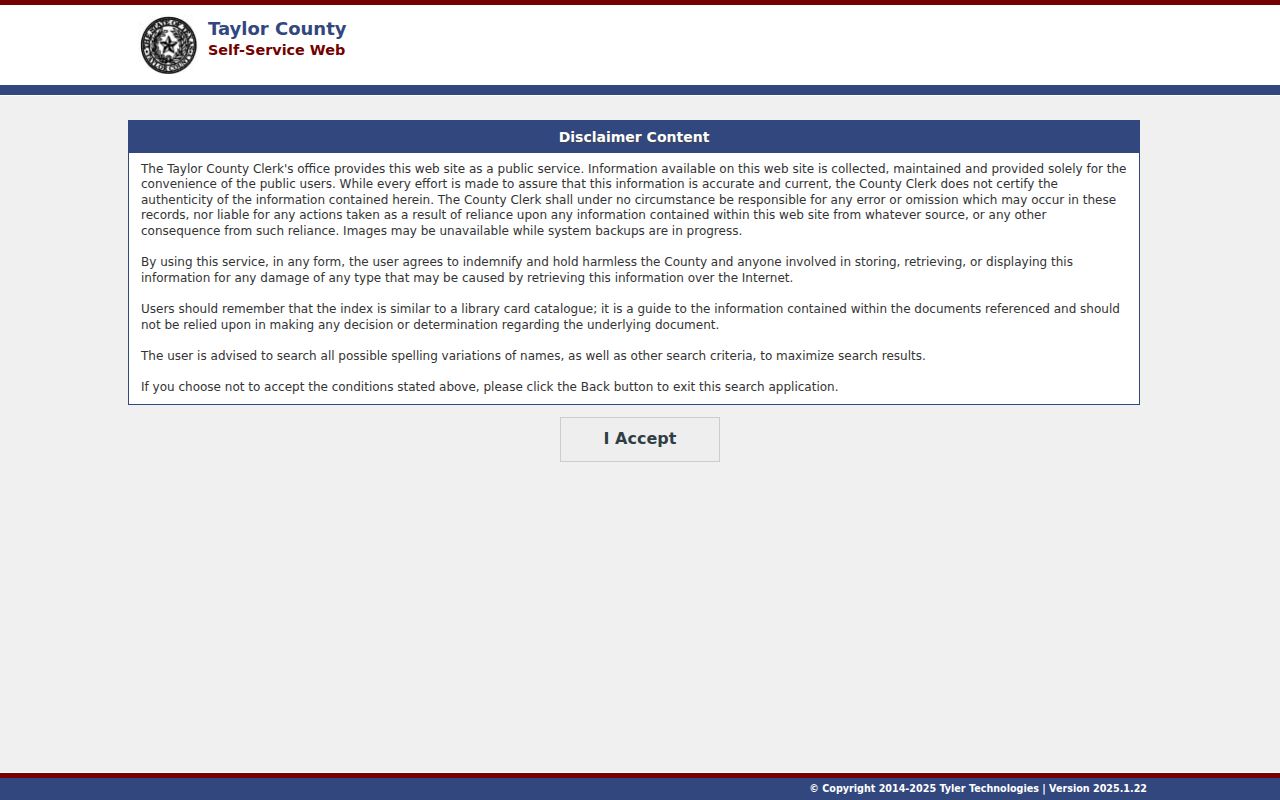
Locate the record in the portal first, then request a certified copy from the County Clerk when certification matters. The office offers free viewing on eight official-public-record terminals and two court terminals. If every machine is busy, the county may apply a 15-minute limit.
Abilene Court Records by Category
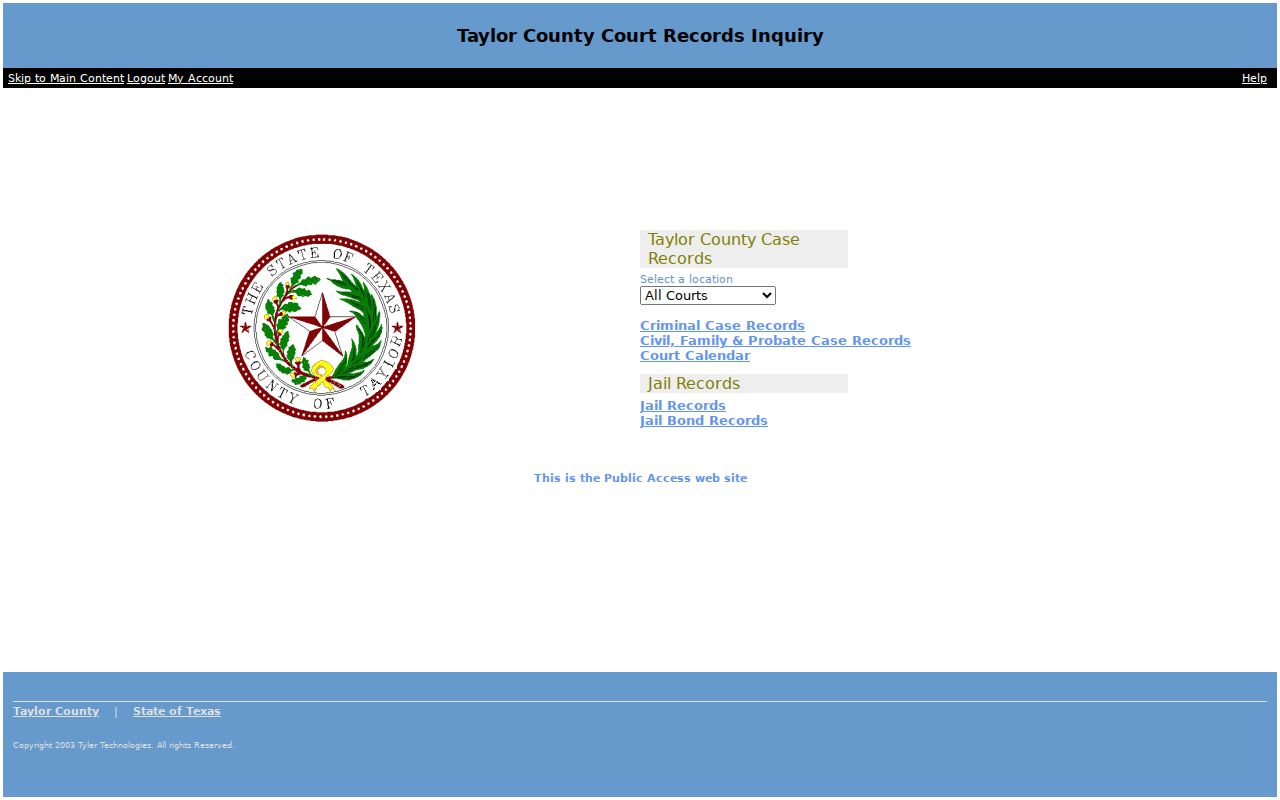
Taylor County splits its online Court Records Inquiry into five doors. Criminal Case Records comes first. Civil, Family and Probate Case Records comes second. Court Calendar, Jail Records, and Jail Bond Records round out the list. Pick the right category before you search. A calendar screen or a custody listing is not a full court file. Reading one as if it were invites confusion. The live search fields and result columns show themselves once you open the current form.
Civil filings are a different story. The District Clerk puts online civil records at filings after September 1994. Anything earlier needs a request by mail or in person. The form asks for a case number if you have one. It also wants plaintiff, defendant, year of filing, a phone number, and whether you want certified copies. No case number means a $5 research charge. Copied pages run $1 each. Older material stored off site can take up to two weeks.
The Taylor County court landing page lists every court and jail entry point.
A docket entry names a case event, a party, or a filing. It does this inside that court system. That is all it does. It settles no questions about identity, allegations, or how a case ended. Sealed, juvenile, and expunged material may be missing or redacted.
Current Abilene Resident Directories
No single list covers everyone living in Abilene. Each current source holds one slice of the picture. The CAD property roll names owners and offers property clues. The county index lists parties to recorded instruments. A paid voter-data request through the Secretary of State can return registered-voter fields, but it is not a free reverse-address search. City records may show an administrative event tied to an address, and an association certificate names a recorded association rather than its members.
| Source | Who It Lists | Keeper | Access |
|---|---|---|---|
| Taylor CAD property roll | Owner and parcel clues | Taylor CAD | Free online search |
| Texas voter data file | Registered-voter fields and participation codes | Secretary of State | Paid request, affidavit, and limits |
| County official-records index | Parties to deeds, liens, plats, and instruments | Taylor County Clerk | Free index; certified copies from clerk |
| City MyGov address route | Permit, occupancy, code, or report activity | City of Abilene | Public landing page; fields vary |
| HOA management certificates | Recorded association and location clue | Texas state database | Free search; not a membership roster |
Pick the source that answers one narrow fact first. Then test it against a second custodian. A property card points toward a deed. A directory line points toward a newspaper date. A court listing points toward the file keeper. The Abilene resident lookup route is built around exactly that kind of one-person verification. Keep expectations modest. No public source proves every occupant of a parcel, and protected or unregistered people may never appear at all.
Abilene Voter File Fields and Limits
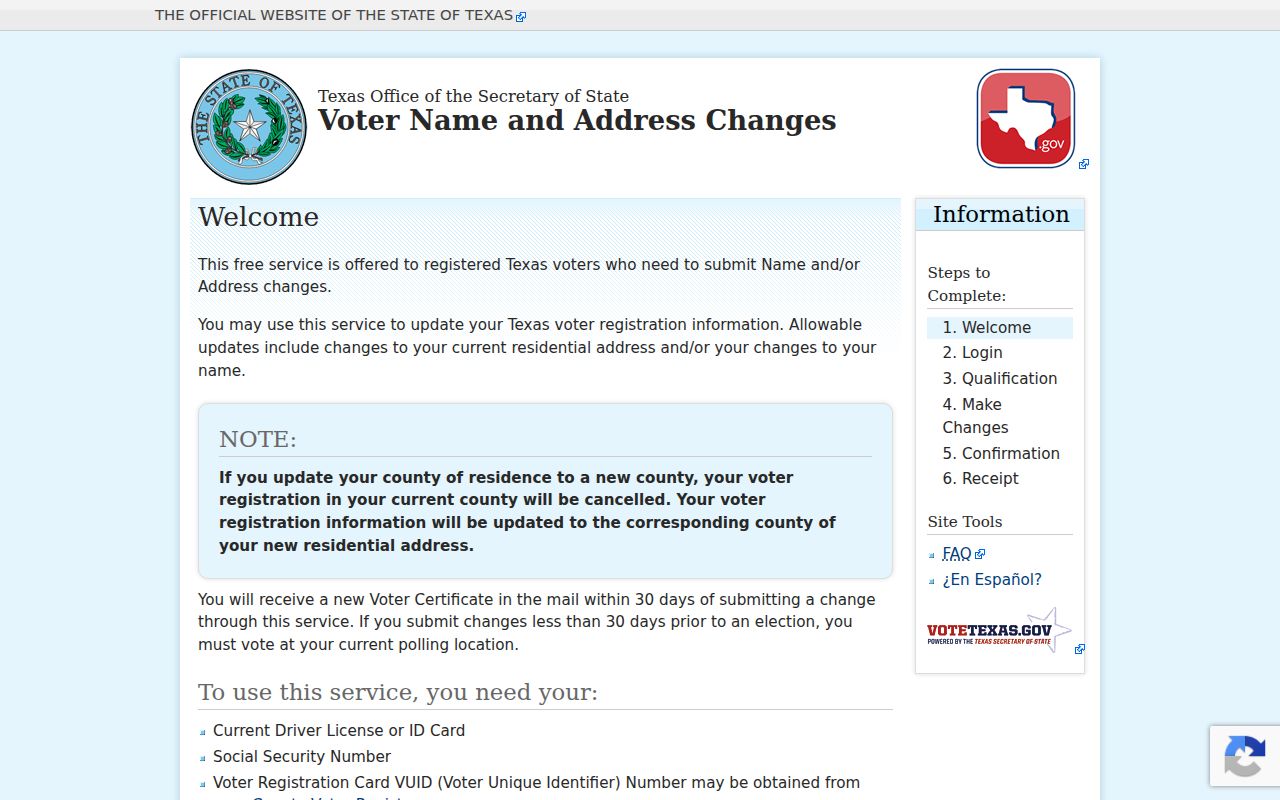
Texas gives voters two very different routes. One is the online voter-service manager, a self-service workflow for registering, qualifying, updating, confirming, and getting receipts. It asks the voter for identifying details so it can process a change. It is not a public name and address directory. The other route is the statewide public voter file, obtained through a Secretary of State request form. That route involves paid delivery by CD-ROM or FTP, an affidavit or notary step, a deposit, and your choice of counties or precincts.
The fixed-width layout can carry county code, precinct, VUID, name components, date of birth, residence and mailing fields, city, ZIP, status, and listed election participation. It never shows how anyone voted. Social Security, Texas driver-license, and personal-identification numbers stay protected, and confidentiality programs plus protected categories can hide certain people from ordinary view. Treat a voter row as one registration clue. It is not a census of an address.
Texas voter services presents the self-service manager workflow.
A Taylor County question can go straight to the Elections office. It confirms the local registration route. Keep any lawful voter-file request limited to the geography and fields you need, and follow the state instructions closely.
Texas Vital Rules for Abilene Families
Texas vital records are not an unrestricted Abilene residents directory. The state keeps birth and death certificates or verifications separate from marriage and divorce verifications. The proper route depends on the record type and on eligibility. Under Texas guidance, births stay protected for 75 years and deaths for 25 years. Those periods have not closed yet. Only an immediate family member or another qualified person with legal authority can use the eligibility procedure. A broad name request will not get through.
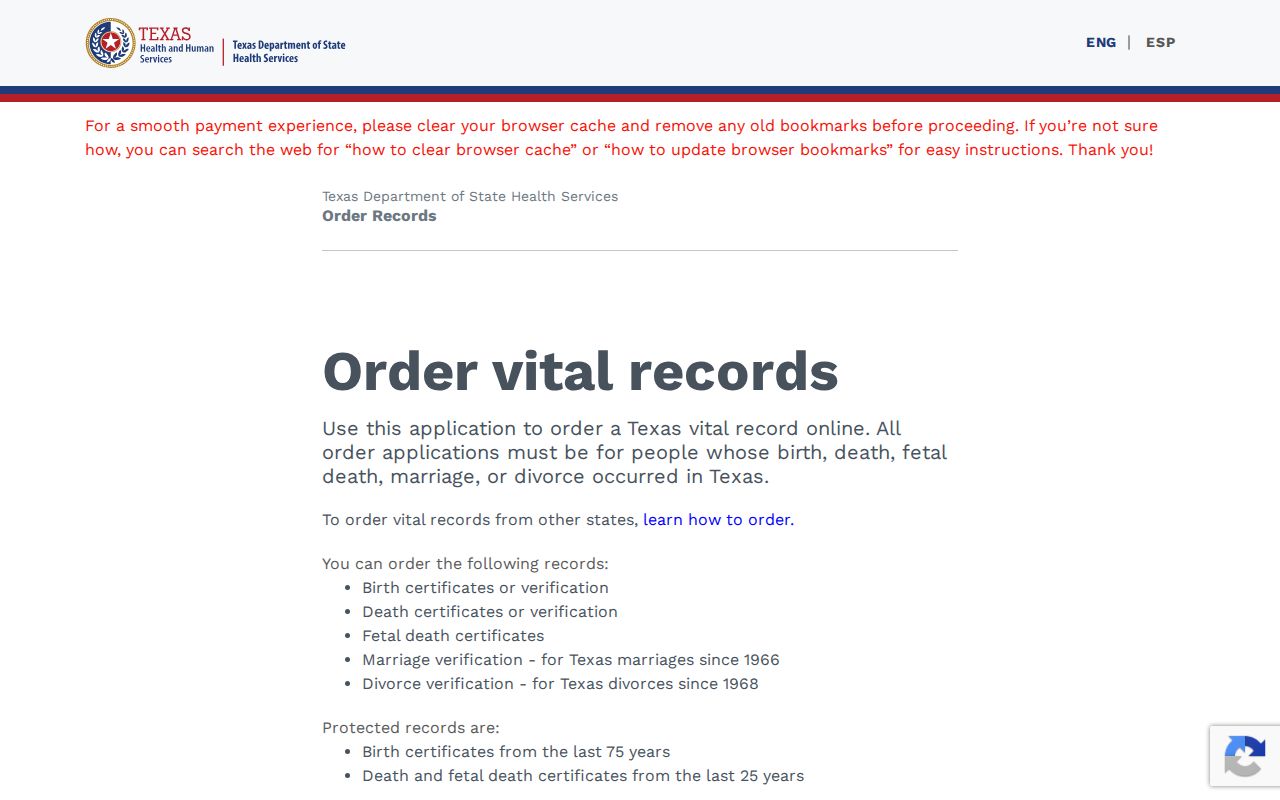
The online order flow opens with a confirmation step. The applicant confirms age and that the event happened in Texas. From there it walks through record type, protected-record authority, applicant contact information, event-person details, delivery, payment, and certification prompts. Most orders take 20 to 25 business days. Payments are nonrefundable. Older Taylor County marriage material sits outside this flow. It can be pursued through the County Clerk or through cataloged genealogy collections. An obituary or a directory entry may supply a lead. Neither replaces the lawful certificate route.
Texas Vital Records Online shows the official record-type and eligibility start.
A verification is not a certified certificate. For forms, corrections, and state instructions, use the DSHS and Texas.gov routes. Then check your selected form for current ID and fee requirements.
Abilene Public Information Requests
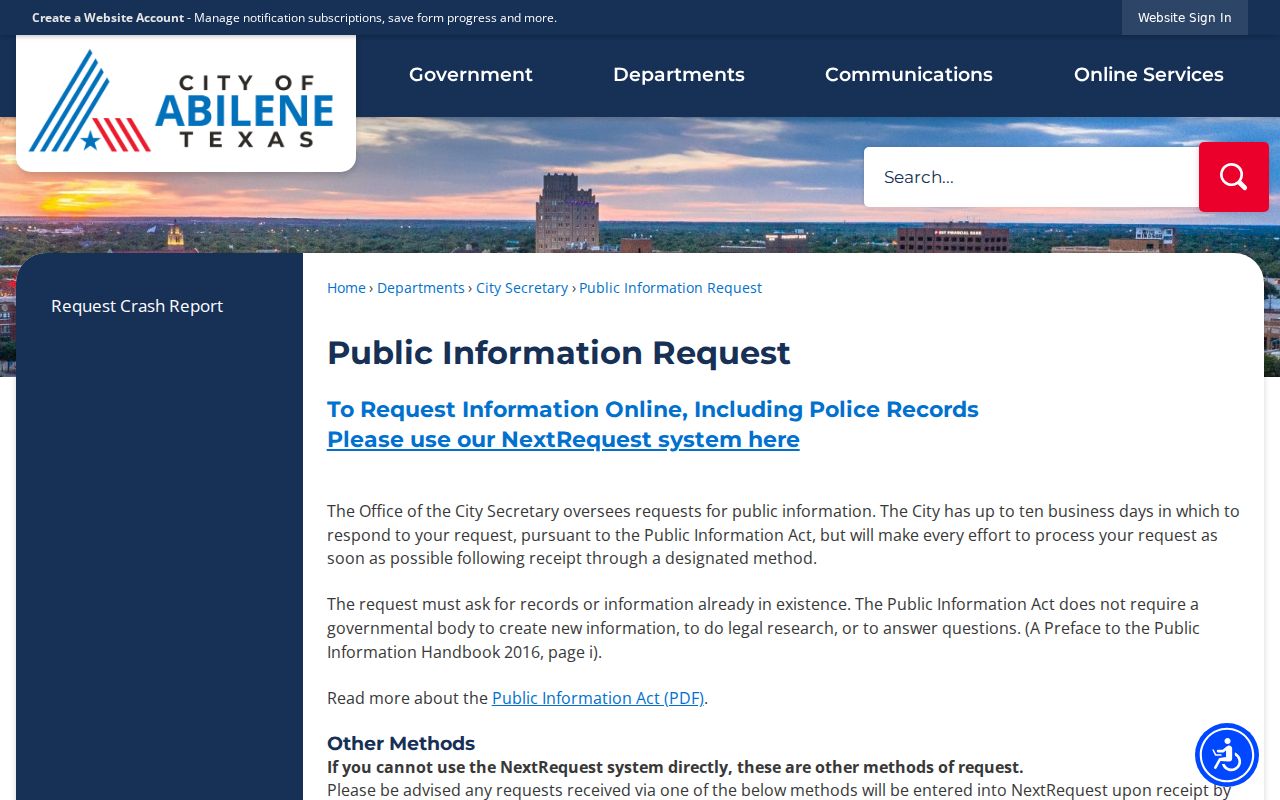
Abilene keeps some records outside its public portals. For those, the city uses its Public Information Act procedure. A strong request names the document or incident, using an address, a date, a report number, or a person or business name. The city will not build a new list or answer a research question. Requests go through the city's NextRequest channel, email, or approved in-person routes at the City Secretary or APD Records.
Expect an answer within up to 10 business days. Charges above $40 trigger an itemized estimate. The posted rates are $0.10 per page, $3 per DVD, $1 per CD, and $15 per hour for personnel time plus 20 percent overhead. These are city terms. They can change. Ask for an estimate on any large request. Texas Public Information Act exceptions and other statutes may require redaction or withholding. Abilene's public-information request instructions spell out each available channel.
Aim each request at the right custodian. MyGov and Building Inspections track address activity, Planning holds map and development context, and APD Records handles written police-report requests.
Abilene Cemetery and Newspaper Trails
Historical questions call for historical tools. The Abilene Municipal Cemetery offers a local burial route rather than a general people search. The city says its online map can locate a grave. Block numbers and burial questions go through the cemetery office. Local materials name five burial grounds: City, Masonic, Cedar Hill, Cedar Hill Flat, and IOOF. The Parks and Recreation Master Plan flags Florence Phillips's 1881 grave in the Masonic section as the oldest documented grave in that plan.
The Main Library's databases add dates and family context to a directory name. Texas Historical Newspapers carries the Abilene Daily Reporter for 1910-1937, the Abilene Morning News for 1926-1936, and the Abilene Reporter-News for 1944-2005. In July 2026, the library expanded its America's News NewsBank subscription for valid-card users. That expansion added more than 4,000 sources. More than 200 of them cover Texas. A cemetery location or newspaper notice is a lead. Check it against its source date.
Note: The cemetery office, not an inferred map label, answers detailed burial and block questions for a local grave.
Historical Abilene Resident Directories
Abilene's directory trail starts early. A digitized 1901 Census and Directory of the City of Abilene and a 1905 City Directory lead the way. Worley and Polk volumes follow. The Texas State Library lists Abilene runs for 1919, 1921, 1939-40, 1942, 1948, 1951, 1953, 1955, 1957, 1958, 1960-63, 1965-82, 1983-84, and 1985-92. UNT catalog material adds more digitized volumes, including Polk pages into the early 2000s. Every run has gaps. Each publisher brought its own context.
An entry can mix a name, address, occupation, business, spouse, children, and a room or rental marker. The 1901 book uses block intervals like “bt. 2 and 3.” The 1905 volume can show family lines. The 1939-40 Worley format leans on conventions such as h for home and r for room or rental context. OCR misreads surnames and street names alike. Compare the page image before copying a result. The Abilene city directory collections give these reading conventions their full treatment.
Abilene Library Bridges Directory Gaps
The Main Library's Texas History and Genealogy room is the place to turn. Use it when a digitized directory skips a year. It also helps when an online portal will not surface an older record. Print genealogical material, microfilm readers, public computers, annuals, family histories, indexes, and staff assistance are all on hand. Ancestry Plus works inside the library. HeritageQuest reaches city directories, census material, and mortality schedules through the library's route.
Treat a directory year as one thread, not the whole cloth. Pair it with the nearest census. An obituary, a newspaper notice, a probate item, or a Sanborn map can add fuller context too. The 1896 Library of Congress Sanborn record holds five Abilene sheets, useful for block and building detail. Texas State Library tax rolls can help as well. Taylor County is absent from the filmed Series 4 1948-1959 list, though. The library also notes those onsite rolls cannot be borrowed through interlibrary loan or fetched by a staff search.
- Index
- A finding aid with names or identifiers that may not include the full source image.
- Parcel
- A mapped land unit identified by an appraisal or geographic ID.
- Criss-cross directory
- An address-oriented directory arrangement used to trace an older occupant by street.
- Certified copy
- A custodian-issued copy with its own fee and eligibility rules, unlike an ordinary web printout.
Abilene Boundaries Change Record Clues
Place labels deserve a date. The Texas State Library notes that neighboring Impact appears in the 1988 Abilene directory. So a directory's place name does not guarantee today's municipal geography. Postal labels create another distinction. The ZIPs 79697, 79698, and 79699 are university unique-use ZIPs, not neighborhood population zones. City Planning maps city limits, ETJ, and county boundaries separately.
Check the year, county, precinct, source custodian, and label first. That discipline matters in Abilene. Its 1881 railroad founding, 1883 incorporation, and county-seat role shaped the older record trail. A county property image shows one layer. A city directory line shows another. A newspaper event and a current map can each describe a different layer of the same place.